



Related Pages
- Headteacher's Welcome
- Vision and Values
- British Values
- Governing Body
- Staff
- School Tours
- School Tour Gallery
- Curriculum
- Curriculum by Subject
- Cultural Capital
- EYFS Curriculum
- Reading at Epping Primary
- How We Teach Phonics
- How We Teach Maths
- Assessment
- KS2 SATs
- myHappymind
- Growth Mindset
- Trauma Perception Practise
- Mind in West Essex
- Friends of Epping Primary School
- Wellbeing
- Sport and PE
- Epping Forest School-Led Improvement Partnership
Reading at Epping Primary
At Epping Primary School, reading is at the heart of our curriculum. We value reading as a crucial life skill. By the time our pupils leave us, they read confidently for meaning and regularly enjoy reading for pleasure. Our readers are equipped with the tools to tackle unfamiliar vocabulary. We encourage our children to see themselves as readers for both pleasure and purpose.
How we learn to read
Reading is taught after the first two weeks of pupils starting in reception. We use the following phonics and reading programmes/strategies below to support our pupils at different stages of their reading development:
How we teach phonics and early reading (Early Years and Key Stage 1)
- Phonics teaching begins in the second week of Reception to ensure children make a confident and successful start to learning to read.
- Children in Reception and Year 1 follow the carefully planned progression of the Little Wandle Letters and Sounds Revised programme.
- Daily phonics lessons are delivered to develop children's reading and spelling skills, with a review and consolidation session taking place each Friday.
- By the end of Reception, children are expected to have completed Phase 4 of the programme.
- By the end of Year 1, children will have completed Phase 5 of the programme.
- Reception phonics sessions begin at around 15 minutes each day, alongside additional daily oral blending activities, before increasing to approximately 30 minutes as children progress.
- In Key Stage 1, daily phonics lessons are typically 25 minutes in length.
Reading Sessions EYFS and Y1
- Children in Reception, Year 1 and beyond (where appropriate) apply their phonics knowledge by reading a fully matched decodable book in small-group reading practice sessions.
- Sessions last approximately 20 minutes, take place at least three times a week and typically include around six pupils.
- Reading practice follows the Little Wandle Letters and Sounds Revised structure, providing opportunities to develop decoding, prosody and comprehension skills.
- Pupils take the same decodable book home the following week to build confidence, fluency and enable families to share in their reading success.
- In Reception, reading practice sessions begin in Week 4. Children who are not yet blending take home a wordless book to develop early reading behaviours and storytelling skills.
How do we assess pupils phonic knowledge?
- In Reception and Year 1, each week concludes with a review session to consolidate and revisit the week's phonics learning.
- Planned and responsive review weeks are built into the programme to revisit key learning and address gaps identified through ongoing formative assessment.
- Pupils identified as being at risk of falling behind receive daily Keep-up sessions, delivered in line with the Little Wandle Letters and Sounds Revised programme to ensure they keep pace with their peers.
- In Reception and Key Stage 1, pupils are assessed at the end of each half term using the Little Wandle Letters and Sounds Revised assessment tracker to monitor progress and inform teaching.
- Pupils accessing the Rapid Catch-up programme are assessed every four weeks to monitor progress and adapt support where needed.
- All Year 1 pupils complete the statutory Phonics Screening Check in the summer term.
- Pupils who do not meet the expected standard in Year 1 retake the Phonics Screening Check in Year 2 and continue to receive targeted phonics support to secure the required knowledge and skills.
Year 2 Fluency
- Pupils in Year 2 who have completed the Little Wandle phonics programme but are not yet fluent readers take part in the Little Wandle Fluency programme.
- Fluency sessions take place daily using fully decodable books that are closely matched to each pupil's reading ability.
- Pupils read daily to build reading accuracy, automaticity, confidence and prosody (reading with expression).
- Adults model fluent reading and explicitly teach phrasing, expression and punctuation to support comprehension.
- Sessions include opportunities for repeated reading, discussion of vocabulary and comprehension, and feedback to improve fluency.
- Pupils' progress is monitored regularly to ensure they are developing the skills needed to become confident, independent readers.
- Teachers listen to pupils in Year 2 read their Little Wandle Fluency book twice a week. Each of the 6 chapters are read over a two-week cycle, with one session each week dedicated to independent reading to develop fluency, confidence and reading stamina.
How we teach phonics and Early Reading beyond Year 1
In Year 2, children revisit and address any remaining gaps in their phonics knowledge during the autumn term to support fluent reading.
Children in Year 2 and above who are not yet secure in their phonic knowledge and require additional support to master the Phonic Code follow the progression outlined in the Little Wandle Letters and Sounds Revised Rapid Catch-up Programme.
The Rapid Catch-up Programme follows the same core content as the main phonics programme but is delivered at a significantly faster pace to accelerate progress.
Children take part in daily Rapid Catch-up sessions, which include three phonics lessons each week, a review session on Wednesdays, and three Reading Practice Sessions (see below).
Each Rapid Catch-up session lasts 30 minutes.
Whole Class Reading from Year 3 onwards
From Year 3, pupils take part in daily or regular whole class reading lessons.The teacher selects a high-quality, age-appropriate text that all pupils access together, regardless of individual reading ability.
Texts include a range of fiction, non-fiction and poetry to develop reading stamina, vocabulary and knowledge across the curriculum.
Teachers model fluent, expressive reading while pupils also have opportunities to read aloud and read sections independently.
Lessons focus on understanding the text rather than simply decoding words, building pupils' confidence as readers.
New and ambitious vocabulary is explicitly taught before, during and after reading to deepen understanding.
Teachers use questioning, discussion and retrieval activities to ensure all pupils actively engage with the text.
Pupils are encouraged to justify their answers using evidence directly from the text.
Scaffolding and targeted support ensure that all pupils can access the learning while appropriate challenge extends more confident readers.
Teachers read with pupils in KS2 by ‘tapping in’ to their reading during whole class reading sessions and 1:1 reading sessions.
Teachers use the 30-minute Whole Class Reading model below to provide a consistent structure for reading lessons, ensuring explicit teaching of vocabulary, fluency and comprehension through high-quality texts.
Teaching Reading Comprehension through VIPERS Years 2 - 6
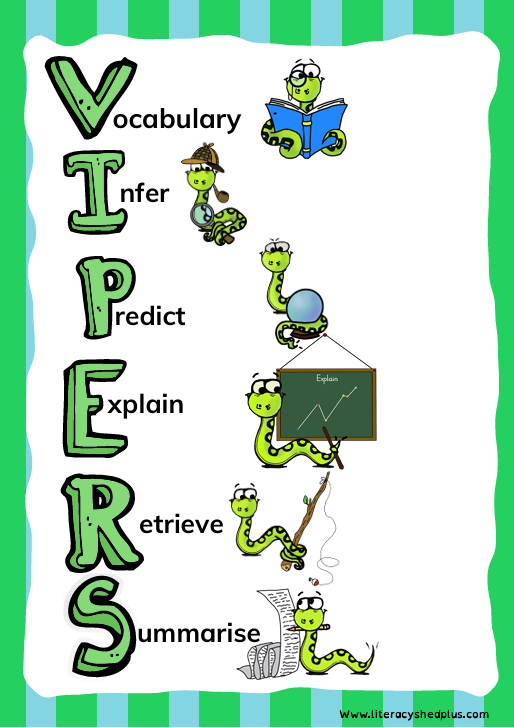
Reading comprehension is taught using the VIPERS approach, which provides a clear structure for developing key comprehension skills.VIPERS stands for:
Vocabulary – exploring the meaning of words and phrases in context.
Inference – using clues from the text to understand characters' thoughts, feelings and motives.
Prediction – making and justifying predictions using evidence from the text.
Explanation – explaining ideas, themes, language choices and author intent using evidence.
Retrieval – locating and recalling key facts and information directly from the text.
Summarising (or Sequencing in Year 2) – identifying the main ideas, key events and important information.
What VIPERS Looks Like in a Lesson
Lessons begin with revisiting previous learning and introducing key vocabulary.
The class reads a carefully selected section of text together, with the teacher modelling fluent reading and thinking aloud.
Teachers ask a range of VIPERS questions, progressing from retrieval to higher-order inference and explanation.
Pupils discuss answers with partners before sharing with the class, promoting high-quality oracy and collaborative thinking.
Children are expected to refer back to the text and highlight or quote evidence to support their responses.
Teachers model how to answer different question types, demonstrating how to use evidence effectively.
Independent or paired activities allow pupils to apply the VIPERS skills through written and verbal responses.
Misconceptions are addressed through discussion and live feedback to deepen understanding.
Lessons conclude with opportunities to reflect on learning, review vocabulary and consolidate comprehension skills.
How do we assess pupils reading in KS2?
Pupils complete FFT Reading Assessments once every half term to monitor reading attainment, identify strengths and next steps, and inform future teaching.
Teachers carry out ongoing formative assessment during whole class reading lessons through targeted questioning, discussion and pupils' responses to VIPERS activities. This enables teachers to identify misconceptions and adapt teaching to meet pupils' needs.
1:1 reading provides additional opportunities for teachers to assess pupils' fluency, accuracy, expression and comprehension, ensuring that individual reading progress is closely monitored.
Assessment information is used to identify pupils who require additional support or challenge, enabling timely intervention and ensuring all pupils make progress as readers.
How do we promote reading for pleasure?
Every classroom has an inviting book corner, and pupils have access to a well-stocked school library, encouraging them to develop a lifelong love of reading.
All classes visit the school library weekly, where pupils can choose a fiction or non-fiction book to take home and enjoy.
Throughout the year, pupils have opportunities to visit the local library to explore a wider range of books and develop independent reading habits.
Every day, pupils enjoy a class story read aloud by their teacher, helping to foster enthusiasm for reading and exposing them to a rich variety of texts and authors.
Every Wednesday, the whole school comes together for a Reading Assembly, where a different member of staff shares a favourite story, promoting reading as a shared and enjoyable experience.
We celebrate World Book Day each year through a range of engaging activities that inspire children to read and celebrate books.
In celebration of World Book Day, we also decorate our classroom doors as a book cover from one of the texts from our year group reading spine.
We host Reading Cafés, inviting parents and carers into school to share books with their children and promote reading together at home.
We regularly invite authors and illustrators to visit the school, giving pupils the opportunity to hear stories first-hand, learn about the writing and publishing process, and be inspired by a love of literature. Most recently, we welcomed Pippa Goodhart, author of the You Choose series and books in the Winnie the Witch collection.
We set a yearly creative homework project where children can create a character or object from a fiction or non-fiction book of their choice using items such as paper plates and boiled eggs, encouraging creativity while celebrating a love of reading.
Reading is celebrated across the school through displays, book recommendations and regular opportunities for pupils to talk about and share books they enjoy with their peers
Reading for Pleasure


Our Whole School Reading Spine
Our whole school reading spine is a carefully selected collection of books that every child will experience during their time at our school. It has been designed to ensure children are exposed to a rich, diverse and inspiring range of stories, authors, genres and themes.
Each year group has a ‘Top 10 Must Reads’ list, carefully chosen to develop children’s love of reading, broaden their literary experiences and introduce them to a variety of high-quality fiction and non-fiction texts.
By the time children leave us in Year 6, they will have encountered 70 ‘must-read’ books, creating a shared reading journey across the school and building a strong foundation of memorable books and authors.
The reading spine promotes reading for pleasure by encouraging children to discover new favourite books, develop their own reading preferences and enjoy the excitement of exploring different worlds, characters and ideas through literature.